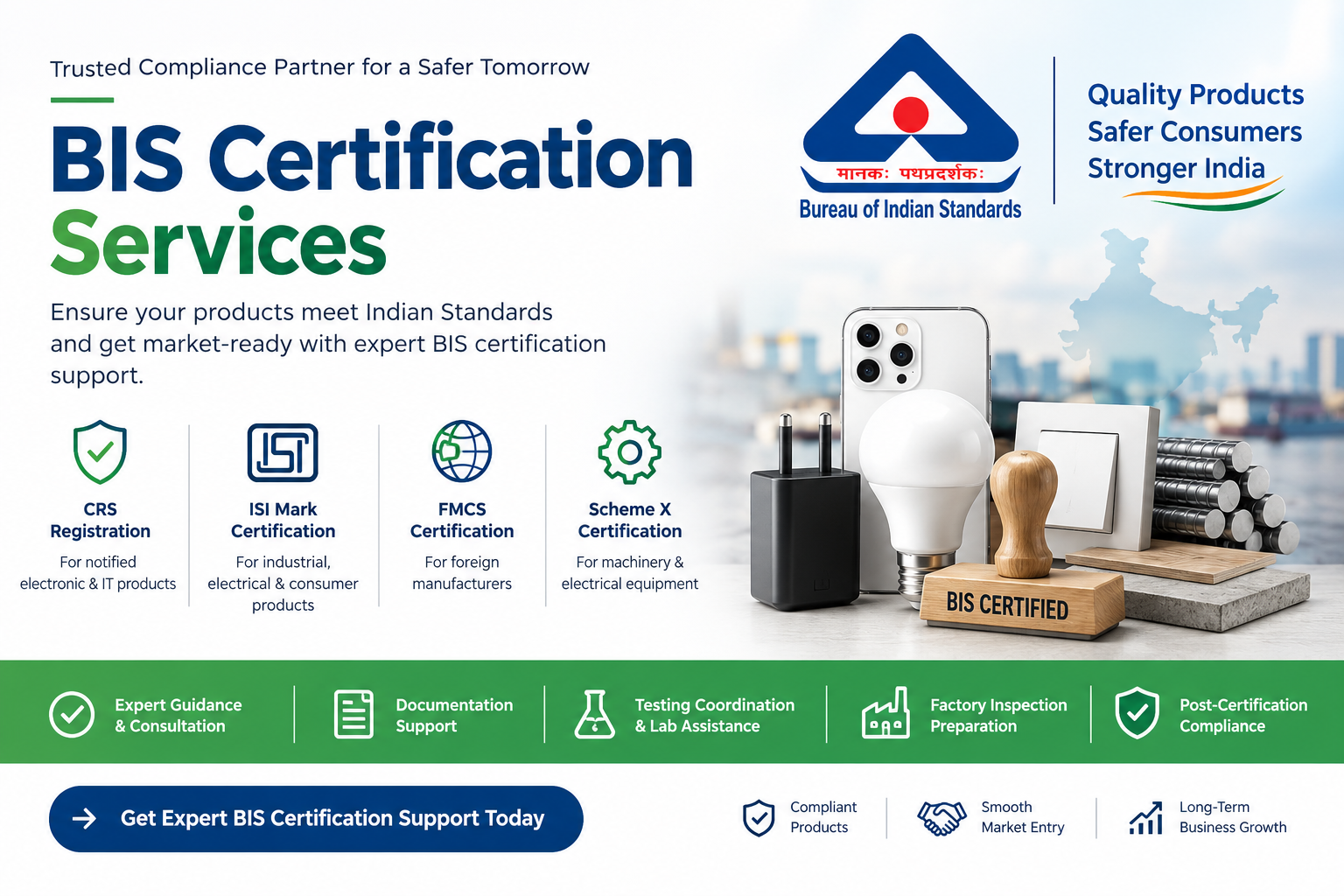
BIS Certification Services play an important role in ensuring the quality, safety, reliability, and compliance of products sold in the Indian market. The Bureau of Indian Standards (BIS) is India's national standards body, responsible for developing Indian Standards and implementing product certification schemes. BIS certification helps manufacturers and importers demonstrate that their products meet the applicable Indian quality and safety requirements.
Businesses dealing in electronics, electrical appliances, industrial equipment, construction materials, furniture, steel products, and other regulated goods may need BIS certification before manufacturing, importing, distributing, or selling products in India. The exact requirement depends on the product category, applicable Indian Standard, and relevant Quality Control Order (QCO) or other government notification.
Professional BIS Certification Services help businesses identify applicable standards, coordinate product testing, prepare documentation, and navigate the certification process. With the right compliance support, manufacturers and importers can reduce documentation errors, avoid unnecessary delays, and understand their regulatory responsibilities.
What Is BIS Certification?
BIS certification is a conformity assessment process through which products are assessed against applicable Indian Standards under the relevant BIS scheme. Depending on the product and regulatory requirements, certification may involve product testing, factory inspection, documentation review, and continuing compliance obligations.
Products covered under mandatory certification requirements generally cannot be manufactured, imported, or sold in India without meeting the applicable requirements and obtaining the necessary approval, subject to the specific rules and exemptions.
BIS certification can help businesses:
Demonstrate product quality and safety.
Meet applicable Indian regulatory requirements.
Improve customer confidence and brand credibility.
Access the Indian market for regulated products.
Reduce the risk of non-compliance and regulatory action.
Establish consistent manufacturing and quality-control practices.
Types of BIS Certification Services
Different products require different certification routes. Understanding the applicable scheme is the first step toward successful compliance.
1. BIS CRS Registration
The Compulsory Registration Scheme (CRS) applies to notified product categories, including various electronic and IT products. Depending on the product, applicable testing and registration requirements must be fulfilled before the product can be placed on the Indian market.
Common product categories may include:
Mobile phones and electronic equipment.
Power adapters and power supplies.
LED products and lighting equipment.
Laptops, monitors, and related IT products.
Batteries and other notified electronic products.
Selected electronic accessories and components.
BIS CRS Registration Services help businesses identify the applicable Indian Standard, coordinate testing through the appropriate laboratory, prepare registration documents, and submit applications through the prescribed process.
2. BIS ISI Mark Certification
The ISI Mark Certification scheme is widely associated with products that must comply with specific Indian Standards. It is relevant to numerous industrial, electrical, construction, and consumer product categories.
Examples include:
Cement and selected construction materials.
Electrical appliances and equipment.
Steel and other notified materials.
Certain furniture products.
Selected pipes, fittings, and industrial products.
Other products covered under applicable certification requirements.
The certification process may involve product testing, factory assessment, evaluation of manufacturing facilities, and verification of quality-control arrangements. The specific requirements depend on the product and applicable BIS scheme.
3. BIS FMCS Certification
The Foreign Manufacturers Certification Scheme (FMCS) enables eligible foreign manufacturers to obtain BIS certification for products intended for the Indian market under the applicable scheme.
Foreign manufacturers may require assistance with:
Identifying applicable Indian Standards.
Understanding mandatory certification requirements.
Coordinating product testing.
Preparing technical and manufacturing documentation.
Arranging factory inspection.
Addressing queries during application evaluation.
Understanding marking and post-certification obligations.
FMCS is particularly relevant to international companies exporting regulated products to India. Certification requirements must be assessed for each product and manufacturing location.
4. BIS Scheme X Certification
Scheme X is a BIS conformity assessment scheme relevant to specified machinery and electrical equipment categories under applicable regulations. It may involve requirements concerning product testing, conformity assessment, and certification, depending on the notified scope.
Businesses manufacturing or importing machinery, industrial equipment, and other potentially covered products should verify the latest applicable orders and implementation requirements before proceeding.
BIS Scheme X Certification Services can help businesses assess product applicability, identify standards, coordinate technical documentation, and understand the steps required for compliance.
5. BIS Certification for New and Regulated Products
BIS requirements continue to evolve as government departments introduce new standards and Quality Control Orders. Manufacturers should regularly assess whether their products are covered by newly introduced or amended requirements.
Products such as furniture, lighting equipment, electrical appliances, steel products, and other regulated goods may have product-specific requirements. A product-by-product assessment is important because similar products can fall under different Indian Standards or certification schemes.
Why Do You Need Professional BIS Certification Services?
Obtaining BIS certification can involve technical, administrative, and regulatory steps. Incorrectly identifying a product standard or submitting incomplete documents may delay the process.
Professional BIS certification consultants can assist businesses in managing the following activities.
Product applicability assessment: Determine whether a product is covered by a mandatory certification requirement and identify the relevant Indian Standard.
Documentation support: Help prepare technical specifications, manufacturing details, test reports, quality-control documents, and other required records.
Laboratory testing coordination: Assist in identifying an appropriate BIS-recognized or otherwise eligible laboratory, as required by the applicable scheme, and coordinating sample submission and testing.
Application assistance: Support the preparation and submission of applications through the prescribed BIS process.
Factory inspection preparation: Help manufacturers understand applicable production controls, testing facilities, quality systems, and inspection requirements.
Query resolution: Assist businesses in understanding and responding to observations or requests for additional information from the relevant authority.
Post-certification guidance: Explain applicable marking requirements, licence conditions, surveillance obligations, renewals, and changes in product scope.
Consultancy support can simplify the process, but certification decisions remain with BIS or the competent authority. No consultant can guarantee approval independently of the applicable assessment requirements.
BIS Certification Process in India
Although the exact process varies by scheme, the following steps provide a general overview.
1. Product identification: Identify the product, its intended use, specifications, and manufacturing location.
2. Applicable standard verification: Determine the relevant Indian Standard and whether certification is mandatory under an applicable notification.
3. Scheme selection: Establish whether the product requires CRS registration, ISI Mark certification, FMCS, Scheme X, or another applicable route.
4. Document preparation: Compile the required technical, manufacturing, and business documents.
5. Product testing: Arrange testing according to the applicable standard and scheme requirements.
6. Application submission: Submit the required application and supporting documents through the prescribed channel.
7. Inspection or evaluation: Complete factory inspection or other conformity assessment activities when required.
8. Compliance review: Address observations, technical queries, or additional requirements raised during evaluation.
9. Certification decision: BIS evaluates the application and determines whether the applicable requirements have been satisfied.
10. Post-certification compliance: Follow licence conditions, marking rules, surveillance requirements, and applicable renewal procedures.
Timelines vary according to the scheme, laboratory availability, documentation quality, inspection requirements, and regulatory workload.
Documents Required for BIS Certification
The documents required depend on the product and certification scheme. Commonly requested documents may include:
Business registration documents.
Manufacturer and factory details.
Product specifications and technical datasheets.
Product photographs and model information.
Manufacturing process details.
Quality-control and testing arrangements.
Test reports, where applicable.
Trademark or brand authorization documents, where required.
Authorized representative details.
Factory layout and equipment details, where applicable.
Other declarations and documents prescribed under the relevant scheme.
Applicants should verify the current checklist for their specific product rather than relying on a generic document list.
Benefits of BIS Certification for Businesses
BIS certification can offer several advantages when it is applicable to a product.
Regulatory compliance: Helps businesses fulfil relevant mandatory product requirements.
Market access: Supports the lawful sale of products subject to mandatory certification.
Customer confidence: Demonstrates that the product has undergone the required conformity assessment.
Quality improvement: Encourages consistent manufacturing controls and product testing.
Business credibility: Can strengthen trust among distributors, institutional buyers, and customers.
Reduced compliance risks: Proper planning helps businesses identify regulatory obligations before launching products.
For importers, early verification is particularly important because certification requirements may affect sourcing decisions, shipment planning, and product launch schedules.
Choosing the Right BIS Certification Consultant
When selecting a BIS certification consultant, consider their experience with your product category, familiarity with the relevant Indian Standards, understanding of current QCOs, documentation process, and ability to coordinate technical activities.
Choose a service provider that offers transparent guidance about fees, testing expenses, expected timelines, and regulatory responsibilities. Avoid relying on claims of guaranteed approval or promises that bypass required testing and assessment.
A reliable BIS certification service provider should explain the applicable process clearly and help you understand the responsibilities that remain with the manufacturer, importer, or authorized representative.
Conclusion
BIS Certification Services help manufacturers, importers, and businesses navigate India's product quality and safety regulations. From BIS CRS Registration and ISI Mark Certification to FMCS and Scheme X, the appropriate compliance route depends on the product, applicable Indian Standard, and current government notifications.
By identifying requirements early, preparing accurate documentation, coordinating testing, and maintaining compliance after approval, businesses can reduce avoidable delays and prepare for successful market entry.
Whether you are launching a new product, importing regulated goods, or expanding your manufacturing operations, professional BIS certification assistance can help you manage the process more efficiently and make informed compliance decisions.
Frequently Asked Questions (FAQs)
1. What are BIS Certification Services?
BIS Certification Services help manufacturers and importers understand applicable Indian Standards, prepare documents, coordinate product testing, submit applications, and manage certification-related compliance activities.
2. Is BIS certification mandatory for every product in India?
No. BIS certification is mandatory for products covered by applicable compulsory certification requirements. The requirement depends on the product category, relevant standard, and government notifications.
3. What is the difference between BIS CRS and ISI Mark certification?
BIS CRS generally covers notified electronic and IT product categories through a registration-based scheme. ISI Mark certification is used under relevant BIS product certification schemes for specified products. The applicable route depends on the product and regulatory requirements.
4. How long does BIS certification take?
The timeline varies by product, certification scheme, laboratory testing, documentation, inspection, and application evaluation. A reliable estimate can be provided after reviewing the specific product and its requirements.
5. What documents are required for BIS certification?
Common documents include business and factory details, technical datasheets, product specifications, manufacturing information, and applicable test reports. Additional documents may be required depending on the scheme.
6. Can foreign manufacturers obtain BIS certification?
Yes. Eligible foreign manufacturers can apply under the applicable BIS scheme, including FMCS where relevant. They must fulfil the prescribed product, documentation, testing, factory assessment, and other requirements.
7. What is BIS Scheme X certification?
Scheme X is a conformity assessment scheme applicable to specified machinery and electrical equipment categories under relevant regulations. Businesses should verify the latest applicable scope and orders before applying.
8. Can a BIS certification consultant guarantee approval?
No responsible consultant can guarantee approval. The decision depends on compliance with the applicable standards, testing, documentation, inspection, and BIS evaluation.
9. What happens if a product requires BIS certification but does not have it?
Depending on the applicable law and circumstances, manufacturing, importing, or selling a regulated product without the required approval may lead to enforcement action, penalties, or restrictions on sale.
10. How can I start the BIS certification process?
Start by identifying your product name, model, manufacturer, intended market, and applicable Indian Standard. A product-specific assessment can help determine the correct scheme, documentation, testing, and application requirements.