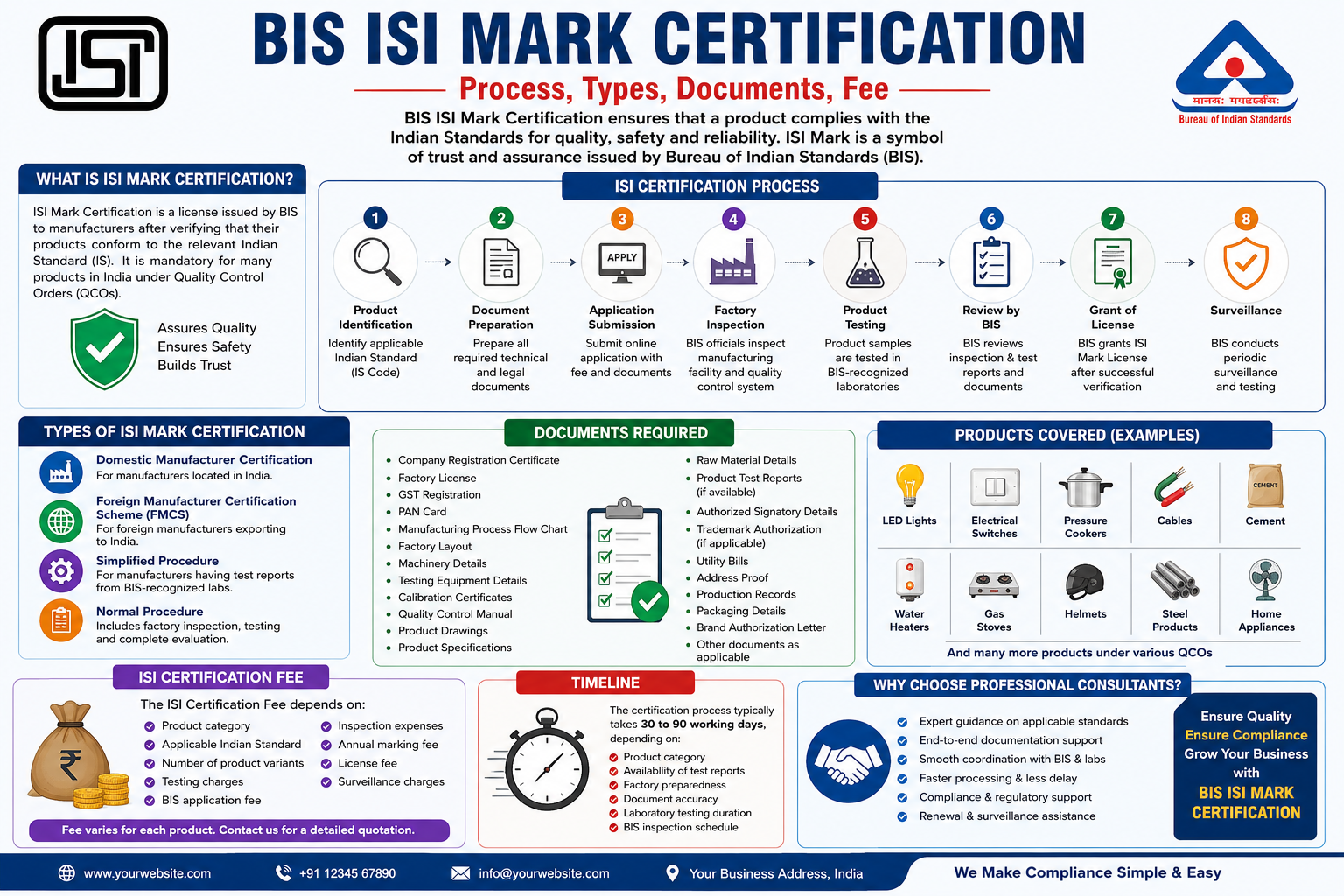
The BIS ISI Mark Certification is one of the most recognized quality certifications in India. Issued by the Bureau of Indian Standards (BIS), the ISI Mark Certification ensures that a product complies with the applicable Indian Standards and meets the required quality, safety, and performance requirements. For manufacturers, obtaining an ISI Mark Certification is not only a legal requirement for many products but also a powerful way to build customer trust and improve market credibility.
Whether you manufacture electrical appliances, cement, steel products, pressure cookers, cables, or other regulated products, obtaining a BIS ISI Mark Certification is essential before selling your products in the Indian market.
What is ISI Mark Certification?
The ISI Mark Certification is a product certification scheme operated by the Bureau of Indian Standards (BIS). The ISI mark indicates that a product has been tested and manufactured according to the relevant Indian Standard (IS). The mark assures consumers that the product is safe, reliable, and of consistent quality.
The ISI mark was introduced by the Indian Standards Institution (ISI), which later became the Bureau of Indian Standards (BIS). Today, the BIS ISI Mark Certification remains one of India's most trusted quality marks.
Manufacturers who receive the certification are authorized to use the ISI mark on their products after obtaining a valid BIS license.
Importance of BIS ISI Mark Certification
Obtaining an ISI Mark Certification offers numerous benefits to manufacturers and consumers alike.
Some major advantages include:
- Demonstrates product quality and safety.
- Builds consumer confidence.
- Mandatory for products covered under Quality Control Orders (QCOs).
- Helps comply with Indian government regulations.
- Improves product acceptance in domestic markets.
- Enhances brand reputation.
- Reduces legal and compliance risks.
- Supports participation in government tenders.
- Increases customer satisfaction.
Products without mandatory ISI Mark Certification may face restrictions on manufacturing, import, distribution, or sale in India.
Types of BIS ISI Mark Certification
There are different certification schemes available depending on the manufacturer and product category.
1. Domestic Manufacturer Certification
This certification is applicable to manufacturers located in India. BIS conducts factory inspections, product testing, and quality management assessments before granting the license.
2. Foreign Manufacturer Certification Scheme (FMCS)
Foreign manufacturers exporting products to India can obtain ISI Mark Certification through the Foreign Manufacturer Certification Scheme (FMCS). Under this scheme, overseas manufacturing facilities are inspected by BIS officials before approval.
3. Simplified Procedure
Manufacturers who already possess product test reports from BIS-recognized laboratories may apply through the simplified procedure for faster processing.
4. Normal Procedure
Under the normal procedure, BIS conducts factory inspections, collects product samples, and sends them for testing before granting certification.
Products Covered Under ISI Mark Certification
The Government of India has made ISI Mark Certification mandatory for numerous products, including:
- Electrical switches
- LED lighting products
- Electric irons
- Pressure cookers
- Cement
- Steel products
- Household electrical appliances
- PVC cables
- Water heaters
- Gas stoves
- Packaged drinking water
- Helmets
- Automotive components
- Kitchen appliances
- Building materials
- Chemicals
- Industrial equipment
The list continues to expand under various Quality Control Orders (QCOs).
BIS ISI Mark Certification Process
The ISI Certification Process involves several stages to ensure that the product consistently complies with applicable Indian Standards.
Step 1: Product Identification
Identify the applicable Indian Standard (IS Code) and determine whether your product requires mandatory certification.
Step 2: Documentation Preparation
Prepare all required technical documents, manufacturing details, quality control records, and legal documents.
Step 3: Application Submission
Submit the online application along with the prescribed government fee and supporting documents.
Step 4: Factory Inspection
BIS officials visit the manufacturing facility to verify:
- Manufacturing process
- Production capability
- Testing facilities
- Quality control system
- Raw material inspection
- Process controls
Step 5: Product Testing
Product samples are tested in BIS-recognized laboratories to verify compliance with the applicable Indian Standard.
Step 6: Review by BIS
BIS reviews inspection reports, laboratory test reports, and submitted documents.
Step 7: Grant of License
Upon successful verification, BIS issues the ISI Mark License, allowing the manufacturer to use the ISI mark on certified products.
Step 8: Surveillance
After certification, BIS conducts periodic surveillance inspections and testing to ensure continued compliance.
Documents Required for ISI Mark Certification
The following documents are generally required for obtaining ISI Mark Certification:
- Company Registration Certificate
- Factory License
- GST Registration
- PAN Card
- Manufacturing process flow chart
- Factory layout
- Machinery details
- Calibration certificates
- Testing equipment details
- Quality control manual
- Product drawings
- Product specifications
- Raw material details
- Product test reports (if available)
- Authorized signatory details
- Trademark authorization (if applicable)
- Utility bills
- Address proof
- Production records
- Packaging details
- Brand authorization letter
Additional documents may be required depending on the product category.
ISI Mark Certification Fee
The ISI Certification Fee depends on multiple factors, including:
- Product category
- Applicable Indian Standard
- Number of product variants
- Factory location
- Testing charges
- BIS application fee
- Inspection expenses
- Annual marking fee
- License fee
- Surveillance charges
Since each product has different testing requirements and applicable standards, the overall ISI Mark Certification Fee varies from one product to another. Manufacturers are advised to obtain a detailed cost estimate before initiating the certification process.
Timeline for BIS ISI Mark Certification
The time required for obtaining BIS ISI Mark Certification depends on:
- Product category
- Availability of test reports
- Factory preparedness
- Document accuracy
- Laboratory testing duration
- BIS inspection schedule
Typically, the certification process may take 30 to 90 working days, provided all documentation and product testing requirements are completed successfully.
Why Choose Professional ISI Certification Consultants?
Many manufacturers prefer experienced consultants because the certification process involves technical documentation, product testing, factory inspections, and compliance with Indian Standards.
Professional consultants help with:
- Product standard identification
- Documentation preparation
- BIS application filing
- Coordination with BIS laboratories
- Factory inspection support
- Compliance guidance
- Query resolution
- Faster application processing
- Renewal and surveillance assistance
Working with an experienced BIS ISI Consultant helps reduce delays and improves the chances of obtaining certification smoothly.
Conclusion
The BIS ISI Mark Certification is a vital quality assurance certification that demonstrates compliance with Indian Standards and enhances consumer confidence. Whether you are an Indian manufacturer or a foreign exporter, obtaining an ISI Mark Certification ensures that your products meet the required safety, quality, and performance standards.
By understanding the ISI Certification Process, Types of ISI Certification, required Documents, and ISI Certification Fee, manufacturers can plan the certification journey more effectively. Timely compliance not only fulfills legal obligations but also strengthens market reputation, improves customer trust, and creates long-term business opportunities in the Indian market.