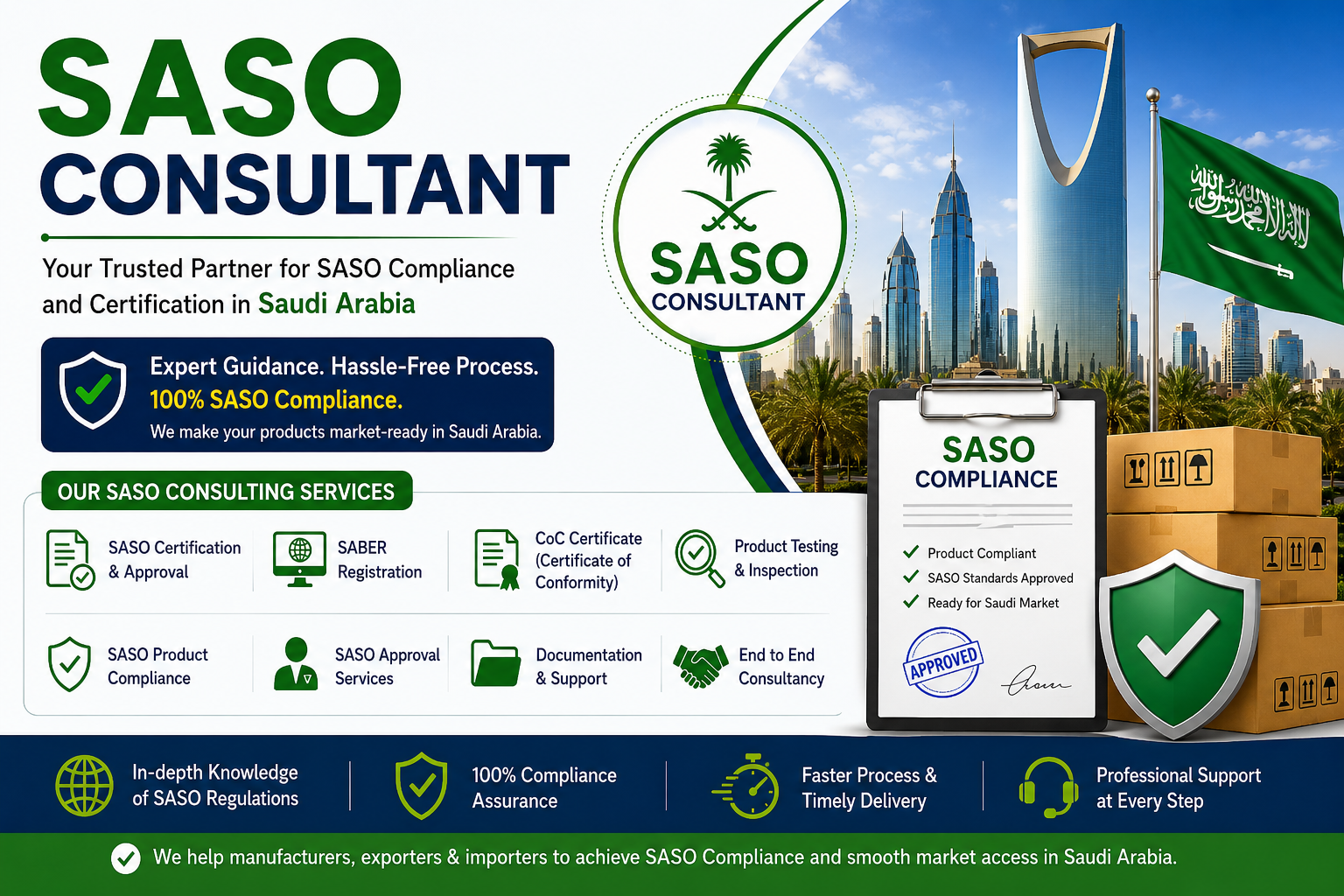
A SASO Consultant helps manufacturers, exporters, importers, and suppliers understand and complete the product compliance requirements for selling goods in the Kingdom of Saudi Arabia. Saudi Arabia has established regulatory requirements to ensure that imported and locally supplied products meet applicable safety, quality, and technical standards. Professional guidance can make the certification and registration process more organized, efficient, and easier to manage.
SASO, the Saudi Standards, Metrology and Quality Organization, develops and oversees standards and technical regulations for various products. For many regulated products entering the Saudi market, businesses need to demonstrate compliance with the applicable Saudi technical requirements. A qualified SASO Consultant provides support in identifying applicable requirements, coordinating testing, preparing documents, completing registrations, and managing certification-related procedures.
What Does a SASO Consultant Do?
A SASO Consultant assists businesses throughout the product compliance process. The first step is generally to identify the product category, applicable technical regulation, Saudi standards, and conformity requirements. Based on the product and its intended use, the consultant can guide the applicant regarding the documentation, laboratory testing, conformity assessment, and registration requirements.
Consultants can also assist with product documentation, including technical specifications, test reports, product photographs, invoices, manufacturer information, user manuals, and other supporting documents. Proper documentation is important because incomplete or inconsistent information can cause delays during the compliance process.
SASO Certification and SABER Registration
Saudi Arabia uses the SABER platform as part of its product conformity assessment system. Businesses dealing with regulated products may need to complete the appropriate conformity procedures through SABER before products can be shipped to Saudi Arabia.
A SASO Consultant can help businesses understand the difference between product-level and shipment-level compliance requirements. Depending on the product and applicable regulations, the process may involve obtaining a Product Certificate of Conformity (PCoC) and subsequently arranging a Shipment Certificate of Conformity (SCoC) for shipments.
The consultant can coordinate the submission of required information and help ensure that product details, manufacturer information, HS codes, test reports, and other documents are properly aligned.
SASO Compliance Process
The SASO compliance process can vary depending on the product category and applicable Saudi technical regulations. A typical process may include:
Product and regulatory requirement identification.
Review of applicable Saudi standards and technical regulations.
Collection and verification of technical documents.
Testing through an appropriate laboratory, where required.
Conformity assessment and certification support.
SABER registration and submission of product information.
Product Certificate of Conformity processing.
Shipment Certificate of Conformity processing where applicable.
Support with documentation required for Saudi customs clearance.
Working with an experienced consultant can help businesses reduce documentation errors and understand each stage before submitting an application.
Why Choose a SASO Consultant?
Saudi product regulations can involve technical standards, conformity assessment procedures, testing requirements, and electronic registrations. Businesses unfamiliar with these requirements may face unnecessary delays or additional costs.
A professional SASO Consultant provides practical assistance by reviewing requirements before the application begins. Consultants can also help identify missing documents, coordinate with testing laboratories and conformity assessment bodies, and follow up on certification-related activities.
This support is particularly useful for overseas manufacturers and exporters who regularly supply products to Saudi Arabia. Having a structured compliance process can help businesses prepare shipments more efficiently and avoid preventable documentation problems.
Products Covered Under SASO Requirements
SASO-related compliance requirements can apply to a wide range of products. Depending on the applicable regulations, these may include electrical and electronic products, lighting equipment, machinery, construction products, building materials, automotive products, toys, textiles, household appliances, chemicals, and other regulated goods.
The exact requirements depend on the product type, technical specifications, intended application, and applicable Saudi regulations. Therefore, businesses should determine the specific conformity requirements for their products rather than relying on a general certification approach.
SASO Consultant for Exporters and Manufacturers
Manufacturers and exporters planning to enter the Saudi market should consider compliance requirements at the beginning of their export planning. A SASO Consultant can review the product portfolio and provide guidance on applicable certification, testing, and SABER-related requirements.
For companies exporting multiple products, consultants can also help organize documentation and compliance activities product by product. This approach can make it easier to maintain records and manage future shipments.
Conclusion
A reliable SASO Consultant can simplify the Saudi Arabia product compliance process by providing assistance with regulatory assessment, documentation, testing coordination, conformity certification, and SABER registration. For manufacturers, exporters, and importers, professional compliance support can help create a smoother path toward meeting Saudi market requirements.
Before exporting products to Saudi Arabia, businesses should identify the applicable technical regulations and confirm whether their products require conformity certification or SABER-related procedures. Professional consultation can help ensure that the required steps are completed correctly and that documentation is prepared according to the applicable requirements.