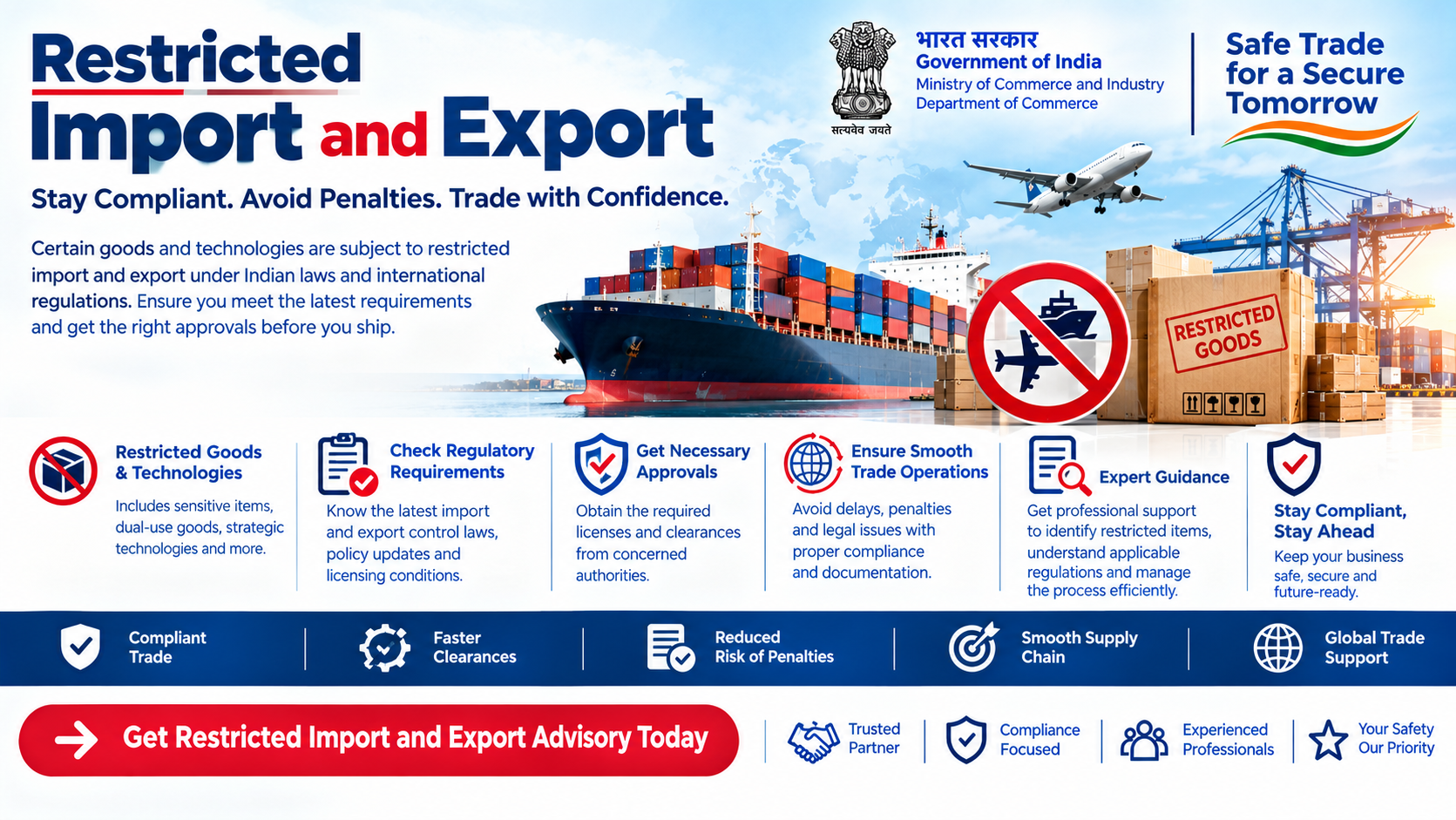
Restricted import and export refers to the international trade of goods that can only be imported into or exported from a country after obtaining specific permissions, authorizations, or licences from the relevant government authorities. In India, the Directorate General of Foreign Trade (DGFT), under the Ministry of Commerce and Industry, regulates the import and export of restricted goods through the Foreign Trade Policy and applicable regulations.
Businesses involved in international trade must understand the rules governing restricted products before importing goods into India or exporting products to foreign markets. These regulations help the government control sensitive products, protect national security, maintain public health, conserve natural resources, and ensure compliance with international trade agreements.
For manufacturers, importers, exporters, distributors, and international trading companies, understanding restricted import and export requirements is essential to avoid shipment delays, penalties, confiscation of goods, and other legal complications.
What Is Restricted Import and Export?
Restricted import and export refers to the movement of specific goods across international borders that requires prior approval, a licence, or authorization from the designated regulatory authority.
Unlike freely importable or exportable products, restricted goods cannot generally be traded without fulfilling the applicable conditions. Businesses must check the product classification, applicable policies, documentation requirements, and licensing procedures before proceeding with a shipment.
In India, the import and export policy of a product is generally identified through its ITC (HS) classification code. This code helps determine whether a product is classified as Free, Restricted, Prohibited, or subject to other conditions under the applicable trade policy.
Depending on the product, additional permissions may be required from authorities such as DGFT, the Directorate General of Foreign Trade, the Central Drugs Standard Control Organisation (CDSCO), the Petroleum and Explosives Safety Organisation (PESO), or other relevant government departments.
Types of Import and Export Policies in India
Businesses should understand the major categories of India's import and export policies before entering international trade.
1. Free Import and Export
Products classified as Free can generally be imported or exported without a specific DGFT licence, subject to applicable laws, customs procedures, product standards, and other regulatory requirements.
However, Free classification does not automatically exempt a product from mandatory certification, safety regulations, environmental requirements, or other applicable permissions.
2. Restricted Import and Export
Restricted products require the prescribed authorization or licence before the relevant import or export transaction can proceed. The applicable conditions depend on the product, its classification, the direction of trade, and the current Foreign Trade Policy.
Businesses must verify the latest DGFT policy and obtain the required approvals before shipping restricted goods.
3. Prohibited Import and Export
Prohibited products generally cannot be imported into or exported from India, except where a specific legal exception or authorization is permitted under applicable regulations.
The rules may vary depending on the product category and the circumstances of the transaction.
4. Conditional Import and Export
Certain products may be traded only after fulfilling specific conditions, such as obtaining a no-objection certificate, complying with technical standards, meeting end-use requirements, or securing approval from a designated authority.
Understanding these categories helps businesses select the correct compliance process and reduce the risk of shipment rejection.
Examples of Restricted Import and Export Products
Restricted product categories may include certain chemicals, defence-related equipment, sensitive technologies, telecommunications equipment, specific pharmaceutical products, precious metals, wildlife-related products, and other goods subject to government control.
The exact policy status depends on the applicable ITC (HS) code and current regulations. A product should not be assumed to be restricted solely because it belongs to one of these broad categories.
For example, a business importing specialized equipment may need to verify whether DGFT authorization or additional technical approvals are applicable. Similarly, an exporter dealing in sensitive goods may need to establish the product's classification, intended end use, destination, and licensing requirements.
Businesses should always verify the latest official policy before finalizing a purchase order or export contract.
Importance of Restricted Import and Export Compliance
Compliance with restricted import and export regulations is important for businesses of all sizes. Proper regulatory planning helps companies manage international shipments efficiently and avoid unnecessary costs.
Key benefits include:
Legal compliance: Helps businesses meet applicable foreign trade laws and government requirements.
Reduced shipment delays: Identifying licence requirements in advance helps prevent customs clearance problems.
Risk management: Reduces the possibility of penalties, confiscation, or rejection of shipments.
Improved business planning: Enables importers and exporters to estimate approval timelines and documentation costs.
International market access: Supports lawful trade with overseas suppliers, customers, and distributors.
Better documentation: Ensures that the necessary licences, certificates, declarations, and supporting records are available when required.
For companies entering new markets, regulatory compliance should be considered an essential part of the import and export strategy.
Documents Required for Restricted Import and Export
The documentation required depends on the nature of the product and the applicable licensing conditions. Businesses may need to prepare the following documents:
Importer Exporter Code (IEC), where required.
DGFT import or export authorization application.
Commercial invoice and packing list.
Purchase order or export contract.
Product technical specifications and catalogue.
ITC (HS) classification details.
Certificate of origin, where applicable.
Bill of lading or airway bill, as applicable.
End-use certificate or undertaking, where required.
No-objection certificate or approval from the relevant regulatory authority, where applicable.
Product-specific licences, registrations, or conformity documents.
Not every document is mandatory for every shipment. Businesses should prepare their documentation according to the applicable product policy, authorization conditions, and customs requirements.
Process for Obtaining a Restricted Import or Export Licence
The licensing process generally involves several steps. The precise procedure depends on the product and the authority responsible for granting approval.
Step 1: Identify the Product Classification
Determine the correct ITC (HS) code based on the product's technical characteristics, composition, function, and intended use. Accurate classification is essential because licensing conditions are linked to product classification.
Step 2: Verify the Current Trade Policy
Check whether the product is Free, Restricted, Prohibited, or subject to specific conditions under the current Indian Foreign Trade Policy and applicable notifications.
Step 3: Identify the Licensing Authority
Determine whether the application must be submitted to DGFT or whether additional approvals are required from another government department or regulatory body.
Step 4: Prepare the Required Documents
Collect the technical specifications, commercial documents, company details, product information, and other supporting documents required for the application.
Step 5: Submit the Application
Complete the applicable application process through the designated government portal or authority. Ensure that all details are accurate and consistent with the supporting documentation.
Step 6: Respond to Queries and Fulfil Conditions
The authority may request additional information, clarification, or documents. Applicants should respond within the prescribed timelines and fulfil any applicable conditions.
Step 7: Obtain Authorization Before Shipment
Where prior authorization is mandatory, ensure that the required approval is granted before undertaking the regulated import or export activity. The shipment must also satisfy customs and any other applicable requirements.
Common Challenges in Restricted Import and Export
Businesses may face several challenges when dealing with restricted goods. These include incorrect product classification, changes in government notifications, incomplete documentation, uncertainty about the licensing authority, and delays in obtaining approvals.
Another common issue is assuming that a licence obtained for one product, transaction, or purpose automatically covers other goods or subsequent shipments. Authorization conditions may limit the product description, quantity, end use, validity period, or permitted transaction.
To minimize these risks, businesses should conduct a regulatory assessment before placing orders, maintain accurate records, monitor policy changes, and confirm all applicable approvals before dispatch.
How Restricted Import and Export Consultants Can Help
Restricted import and export consultants assist businesses in understanding applicable trade regulations and identifying the approvals required for their products. Their support can be particularly valuable for companies dealing with unfamiliar product categories or complex regulatory requirements.
Professional consultancy services may include ITC (HS) classification assistance, import and export policy checks, DGFT authorization guidance, documentation review, identification of additional regulatory approvals, application support, and coordination with relevant authorities.
Consultants can also help businesses understand the conditions attached to an authorization and identify potential compliance issues before a shipment is arranged.
However, the granting of a licence remains subject to the relevant authority's rules, assessment, and approval. Engaging a consultant does not guarantee authorization.
Conclusion
Restricted import and export compliance is an important part of international trade in India. Businesses dealing with regulated products must understand the applicable Foreign Trade Policy, correctly classify their goods, verify licensing requirements, and obtain the necessary approvals before proceeding with a shipment.
A structured compliance process helps importers and exporters reduce regulatory risks, avoid unnecessary delays, and conduct international business more efficiently. By seeking appropriate professional guidance and monitoring current DGFT notifications, businesses can make informed decisions and maintain compliance with India's import and export regulations.
Whether you are a manufacturer, importer, exporter, or trading company, understanding restricted import and export requirements is essential for building a reliable and legally compliant international trade operation.